
09 December 2025
Whatever happened to The Crusader?
An uncomfortable year for the League
The year 1919 was a tumultuous one for the RSSILA. With demobilisation of the Australian Imperial Force (AIF) underway, the fledgling League struggled to manage the challenges that a rapid influx of new members presented.
Although founded on the principle of non-partisanship, a continuum of conflicting political ideologies had emerged that, in the lead-up to a Federal election in December 1919, threatened to rip the League apart.i It was into this maelstrom of organisational instability that The Crusader emerged.

A new crusade begins
In mid-1915, 22-year-old Eric Hanman sustained a gunshot at Gallipoli that paralysed his left hand. Hanman returned to Australia, where he penned his wartime memoirs Twelve Months with the Anzacs. His flair for storytelling led to a job writing for the Queensland Recruiting Committee.
Despite possessing limited formal management experience, he was appointed The Crusader’s first managing editor in mid-1919.ii

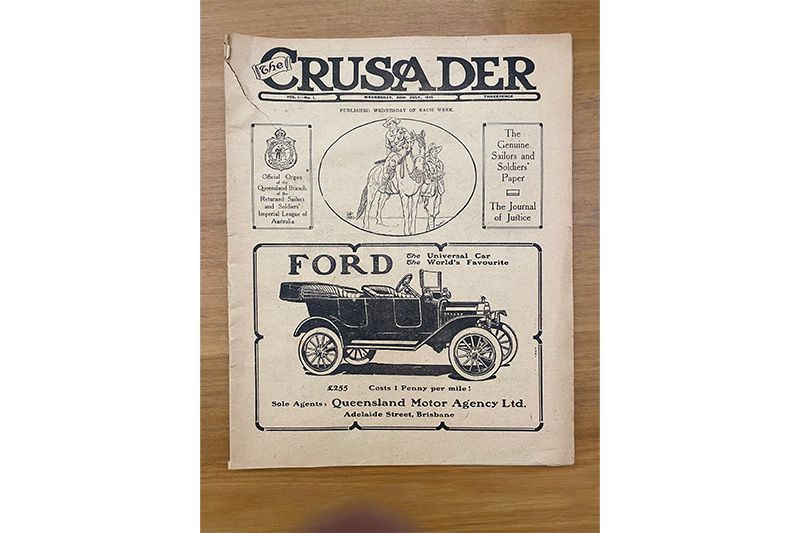
Queensland was the last State Branch to publish a members’ periodical, and it promised readers 24 pages of weekly content “…devoted to defending and protecting the rights of Diggers”.iii Its title tapped into religious and historical principles of service that were common in Australian society at the time.
Some churches likened World War I to a holy crusade, and with more than 93% of the AIF identifying as Christian, the significance of the journal’s name would have been evident to its target audience.iv
The title also suggested an ongoing and righteous battle to combat the injustices visited upon the returned community, and the magazine’s subtitle – The Journal of Justice – set the tone for much of the content within. Hanman assured readers that The Crusader was “…out to see that the Digger gets the fair deal so long denied him… he hates to be patronised, he scorns charity, he wants justice, he demands justice, and by God he is going to get it”.v
‘The Journal of Justice’
The Crusader’s columns often featured criticism of issues that affected the returned community: the failures of the Repatriation Department (known today as the Department of Veterans’ Affairs) and politicians; profiteering; and patriotic fund misuse. However, given the high rate of unemployment facing demobilised troops, Hanman reserved his greatest condemnation for those who failed to give preference to the hiring of returned men.
In September 1919, he called out the Commandant of the 1st Military District (1MD) after an officer who had not seen active service was appointed Area Officer of Bowen. The hapless lieutenant was soon replaced by a returned officer.vi
Editorial accuracy was not one of Hanman’s strengths, and threats of legal action against the League soon emerged in response to his strident criticisms. In 1920, former RSSILA Queensland State President Pearce Douglas was successfully sued for defamation after The Crusader published an article wrongly accusing two Brisbane businessmen of failing to rehire a returned man.vii
Earlier in the year, The Crusader had registered the first of an ongoing series of annual financial losses. A Board of Control (BoC) was established by the RSSILA’s State Managing Council to oversee the publication.
Hanman railed against what he perceived to be a lack of faith in his ability and neither the directions of the BoC nor the outcome of the defamation case modified the stridency of his approach. Hanman’s relationship with the League began to deteriorate.viii
By late 1920, the discord evident in the pages of The Crusader was causing a “good deal of hurt and dissention amongst the members”.ix Calls for reformation of the publication were being made and Sub Branches began cancelling subscriptions.x
Not content on badgering the unpatriotic employer, Hanman continued to target members of the returned community; in mid-1920, The Crusader claimed that the 1MD Commandant and members of his staff were not returned men. State Executive was subsequently embarrassed by the Brigadier-General and his men – one of whom had lost a leg in the war – making an impromptu visit to the RSSILA headquarters to disprove the claims.xi
A political firestorm erupts
After the publication of another contentious article in early 1921, the State Managing Council acted: “Mr Hanman [was asked] to show cause why he should not be dismissed”. xii Two weeks later, the outspoken editor’s contract was terminated.xiii
Hanman’s political ideology aligned closely with that of the progressives. The Daily Standard was the Labor Party’s Brisbane-based mouthpiece and took every opportunity to criticise what it called the Tory Imperial League.xiv A five-week tirade was launched against the League as the Standard “vomit[ted] forth upon the Managing Council” its displeasure over Hanman’s sacking.xv
State Branch responded by publishing extracts of meeting minutes that disproved the provocative nature of the Standard’s reportage before adopting a dignified silence. The appointment of Frederick ‘Jim’ Meacham – an experienced journalist and returned man – as The Crusader’s new editor finally brought the furore to an end.xvi However, by mid-1923 Meacham had moved on, and The Crusader continued to struggle.xvii

The crusade comes to an end
While the political furore that followed Hanman’s departure did not benefit The Crusader’s cause, other factors helped seal its fate. The instability evident within Queensland Branch during The Crusader’s short life did not help matters.
Apart from three different editors, State Branch also experienced six State Presidents and four State Secretaries during the period of The Crusader’s publication. However, this was perhaps to be expected as sailors and soldiers transitioned back into Australian society and learned to live with both the aftermath of their service and expectations of post-war life.
The periodical’s main source of income came from the sale of advertising space and this ultimately led to The Crusader’s end. In 1919, local businesses rushed to exploit the potential of the returned community as men returned home. However, the RSSILA was unable to sustain the numbers recruited during demobilisation.
Of the estimated 15,000 Queensland members in 1919, only 29% remained financial by 1924.xviii With The Crusader’s target readership shrinking, advertising revenue fell and the periodical continued to haemorrhage money.xix
Hubert ‘Frazer’ East was elected Queensland’s ninth State President in February 1924, and his four-year tenure brought a much-needed period of stability and consolidation to the League. Within two months of assuming office he had cancelled The Crusader.
Within 12 months, a new periodical, The Queensland Digger, was launched. xx Within two years, membership of Queensland Branch finally began rising. Despite early calls for it to be abolished, The Queensland Digger thrived and remained its member magazine for another 36 years .xxi
If your Sub Branch has a copy of The Crusader in its archives, please contact us on editor@rslqld.org
References
i Stephen Garton, The Cost of War: War, Return and the Re-shaping of Australia Culture (Sydney University Press: Sydney, 2020 ed), 53-54; and Martin Crotty, ‘The RSSILA 1916-1946’, in M. Crotty and M. Larsson (eds), Anzac Legacies: Australians and the Aftermath of War (Australian Scholarly Publishing: Melbourne, 2010), 174.
ii NAA: B2455 HANMAN E. F.; and J26, M652; Daily Mail, 14 December 1916, 3; & Bulletin, 28 August 1919, 14.
iii Daily Mercury, 19 August 1919, 4.
iv For details of the AIF’s religious composition, see: Bill Gamage, The Broken Years: Australian Soldiers in the Great War (Melbourne University Press, Victoria, 2020 ed), 288.
v Crusader, 30 July 1919, 6. NLA MSS6609, Box 349.
vi Bowen Independent, 6 October 1919, 8; & Cairns Post, 2 October 1919, 6.
vii Northern Herald, 29 October 1919, 40; Daily Standard, 1 April 1920, 6.
viii Daily Standard, 4 March 1921, 5.
ix Evening Telegraph, 12 November 1920, 4.
x See: Ipswich Sub Branch minutes, RSL Queensland Papers; Queensland Times, 18 December 1919, 7; & Evening Telegraph, 12 November 1920, 4
xi Queensland State Executive Minutes, 8-9 July 1920, NLA: MSS6609, Box 350.
xii Daily Standard, 4 March 1921, 5.
xiii Ibid.
xiv For examples of the Daily Standard’s criticism, see 5 July 1919,4; & 21 Jul 1919, 4.
xv Daily Standard, 8 April 1921, 4.
xvi Daily Standard, 4 March 1921, 5; & Maryborough Chronicle, Wide Bay and Burnett Advertiser, 16 April 1921, 4.
xvii The RSSILA advertised for a new editor in May 1922 and E. T. Roper was subsequently appointed. See: Daily Standard, 20 May 1922, 9; & Western Champion, 8 June 1922, 5.
xviii For League membership between 1916-1963, see: G. L. Kristianson, The Politics of Patriotism: The Pressure Group Activities of the Returned Services League (Canberra: ANU Press, 1966), 234.
xix Brisbane Courier, 21 February 1922, 6.
xx Longreach Leader, 25 April 1924, 18; & Telegraph, 24 February 1926, 5.
xxi Longreach Leader, 25 April 1924, 18; & Telegraph, 24 February 1926, 5.