
23 February 2026
Vietnam veteran honours canine comrades
Whenever Australians have gone to war, animals have been by their side.
From the horses that bore ANZAC soldiers into battle, to the pigeons that carried life-saving messages through both World Wars, animals have provided our forces with invaluable support, protection and morale.
Their service and sacrifices are commemorated every year on 24 February, the National Day for War Animals.
That day means “a hell of a lot” to Vietnam veteran Ian Hall OAM.
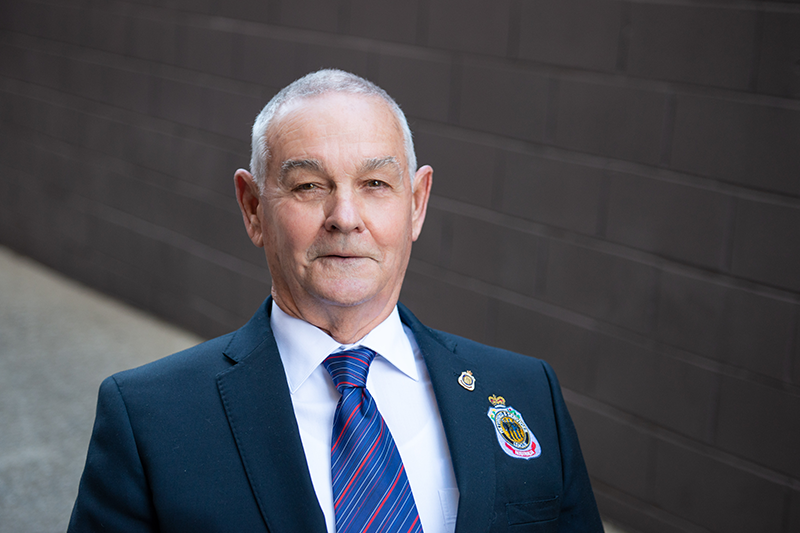
RSL Queensland Life Member Ian Hall OAM served in the Australian Army from 1964 to 1970, including two tours of Vietnam. He is highly involved with the Australian Army Trackers and War Dogs Association.
A Life Member of Maleny RSL Sub Branch and former RSL Sunshine Coast and Regional District President, Ian did two tours of Vietnam – the second (1968-69) as a tracking team commander, visual tracker and dog handler.
Led by tracker dogs, Australian Army tracking teams were crucial in locating enemies and preventing ambushes.
“The dogs were there to help us do our job: to protect members of our team and our battalion, and anybody else who worked with us,” Ian says.
“They saved numerous, numerous lives.”
“They were like our brothers”
Ian’s team’s dogs were Milo and Caesar – two of 11 black Labrador-Australian working dog crosses deployed with the Australian Task Force.
Though chiefly trained to track down enemies and their hideouts, Milo and Caesar became invaluable in other ways – alerting their teams to food caches and booby traps with their “tremendous” senses of smell.
“One of those dogs saved a handler’s life by detecting a booby trap. He stopped at that booby trap and wouldn't allow the handler to go forward,” Ian recalls.
“It was a tripwire set up on an explosive device. Had that been activated, it would've killed the handler and possibly a number of other persons.”
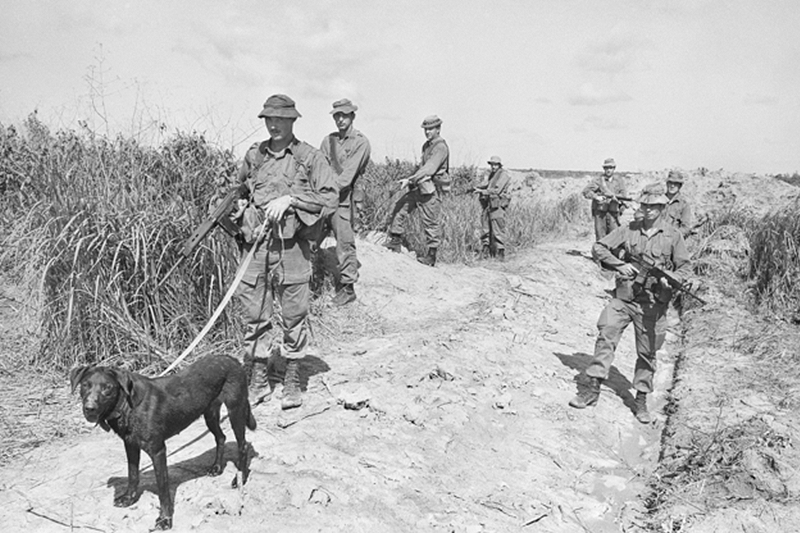
Tracker dog Milo leading the tracker team of 2RAR /NZ (ANZAC) on patrol from Fire Support Base Tess near Nui Dat, Vietnam, in 1970. Image credit Australian War Memorial.
Highly intelligent, hard-working and loyal, Milo and Caesar were as valued as they were beloved by Ian’s team.
“They were real characters. One was a real larrikin and one not so much; they were different personalities altogether. They liked to play, and they also had their quiet moments,” Ian explains with affection.
“They were like our brothers. They were part of our family.”
Even now – nearly 60 years later – Ian can clearly smell the smell of a wet dog huddled against him after a day patrolling in monsoon rain.
“Because you'd spend so much time together, you understood the dog and the dog understood you. You were virtually one and the same,” he says.
“Your relationship was that close.”
All but one of the Australian tracker dogs who served in Vietnam survived. Sadly, however, none were allowed to return home. All the surviving dogs, including Milo and Caesar, were adopted by Australian and European families living in Saigon.
A lifelong dog person, Ian has almost always had a Labrador or Australian cattle dog. Today, he has one of each.
“I really believe that's because of my association with the dogs from the tracking team,” he says.
Recognising service dogs’ legacy
Through his work with the Australian Army Trackers and War Dogs Association, Ian has fought hard to increase recognition of military and protective service dogs.
The Association struck the first dog service medals recognised by the Australian Defence Force (ADF). Now, the ADF awards medals to dogs that go on operational service.
“Service dogs perform a tremendous role. They are an asset, because nothing can really take their place,” Ian says.
“The dog is there as your best friend, and he'll do whatever he can to ensure that you stay safe and your wellbeing is looked after.”
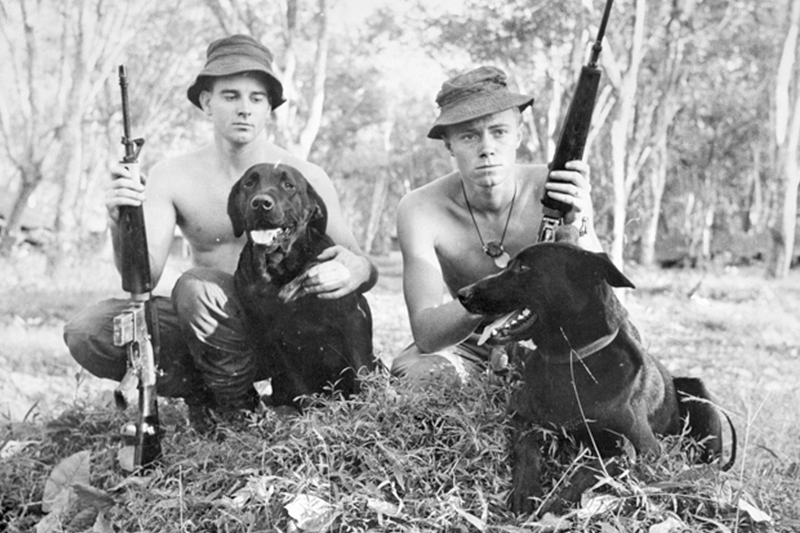
Private Denis Ferguson with tracker dog Marcus (left) and Private Peter Haran with tracker dog Caesar (right) in Phuoc Tuy Province, Vietnam, circa 1967 to 1968.
Ian is forever grateful to Milo and Caesar. He’s living proof of their legacy.
“National Day for War Animals means a hell of a lot to me,” he says.
“When 24 February comes round every year, I think about the dogs I worked with in Vietnam, what they did, and how they allowed me to come home.”
National Day for War Animals
On National Day for War Animals (24 February), RSL Queensland honours the many animals who have served and sacrificed for our nation.
You can take part by wearing a purple poppy and attending a commemorative service near you.
Contact your local RSL Sub Branch for more details.