
28 April 2026
The history of the RSL badge
The significant size of the Returned Sailors’ and Soldiers’ Imperial League of Australia’s (RSSILA’s) first badge reflected the pride and status with which members perceived their position as returned men. At a whopping 30mm x 40mm, the insignia was marginally larger than the Australian Government’s Returned from Active Service badge and it dominated the lapels of the men who wore it.
As time passed and recognition of the badge grew, members began yearning for a smaller insignia. “[It] is somewhat large,” confided then NSW State Secretary Arthur Potter to William Burns, the League’s General [National] Secretary, in early 1918, “and it would certainly meet with [members’] views that the badge be made smaller.”i
However, with the League in its infancy and other matters demanding his attention, Potter was unable to progress the matter further.
A new State Secretary
Following Potter’s resignation in mid-1920, Gallipoli veteran Roland Hastings was appointed NSW State Secretary.ii After settling into his new role, Hastings turned his attention to the badge.
Working with a local firm of returned men, he had six small insignia struck.iii At the January 1921 Federal Executive (RSL Australia) meeting, NSW’s motion to adopt a miniature badge was carried, subject to the majority of RSSILA State Branches agreeing to the change.iv
William Henderson, the then General Secretary, distributed the six sample badges to the State Branches.v When Hastings requested permission to order 5,000 insignia, Henderson reminded him that “until I get permission of the majority of State Executives in regard to the adoption of the miniature badge, the Federal Executive is not empowered to place the order”.vi
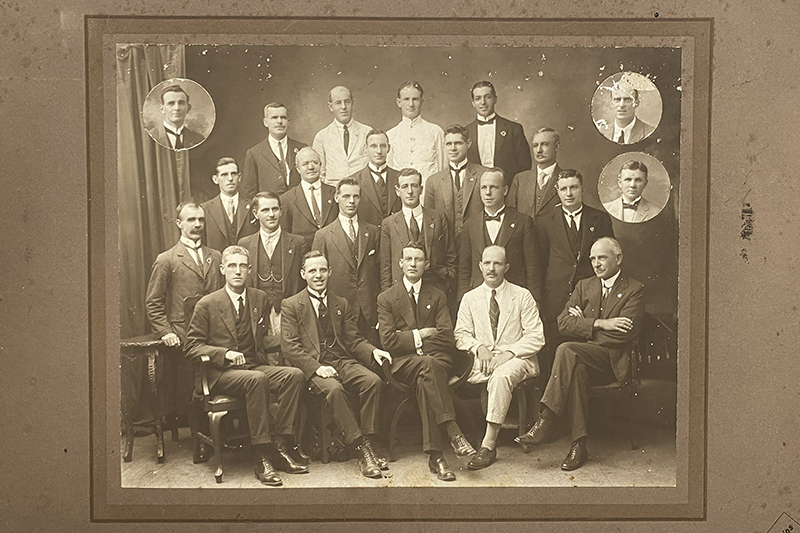
Members of the now defunct Brisbane RSSILA Sub Branch shown wearing both the large and miniature versions of the badges in 1922 (RSL Queensland Papers).
Pros and cons of a new badge
A compelling advantage of the miniature badge was price. Hastings had negotiated the miniature for half the cost – 9 pence (d) – of the large insignia. However, this saving needed to be balanced against the replacement of nearly 50,000 badges nationally.vii
He devised a cost-neutral solution where a member paid 18d for the insignia, its postage and other administrative costs.viii Victoria and NSW immediately agreed to adopt the miniature badge, as did Queensland, but only after the latter exhausted the several hundred badges it had on hand.ix
The timing of the change was another complicating factor. State Branches were issuing the 1921 financial clips – the small metal tag that attached to the crown of the badge and showed a member was financial – and these were too large for the miniature insignia.
The smaller states did not have the same capacity as the larger ones to absorb this cost along with that of a miniature clip. This may have influenced South Australia (SA) and Tasmania to vote against the change.x Western Australia (WA) Branch likewise perceived the miniature badge to be “detrimental to the best interests of the members” but referred the decision to Federal [National] Congress in August 1921.xi
NSW goes its own way
For NSW Branch, waiting six months for Congress was not an option. During 1920, many of its members failed to renew their annual subscription and numbers plummeted from an estimated 15,000 to 8,241 men. In late February 1921, State Executive implemented an ambitious recruitment campaign that relied upon the miniature badge to attract new men and provide State Executive with an accurate census of members.xii
Hastings, who had ordered 10,000 of the diminutive insignia, wrote to Henderson on 2 March 1921. “To holdover the purchase of these badges… until full Congress… would be to defeat the avowed object of the NSW Branch to secure 50,000 financial members in 1921,” he declared, before adding that NSW was “quite prepared to defend their action at the meeting of the Federal Congress”.xiii However, Henderson did not reply. He had been admitted to Caulfield Military Hospital, where he died unexpectedly on 9 March.xiv
Frederick Forrest replaced Henderson as the League’s General Secretary. He did not contest NSW’s actions; the economic advantages of the miniature badge were evident, and its growing popularity made the insignia’s adoption inevitable.
While Forrest remained unable to source the smaller badge, he did acknowledge that State Branches might independently obtain their own.xv Queensland Branch began issuing the new badge in June 1921 after its State Secretary, Edward Dibdin, purchased 1,000 insignia from Hastings.xvi
As anticipated, the miniature badge was adopted as “the official Badge of the League” at the August 1921 Federal Congress.xvii It was also decided that State Branches be empowered to “make their own arrangements for the supply of badges and financial clips”.xviii This change benefited both Federal and State Branches by reducing the onerous workload that managing the badge entailed.
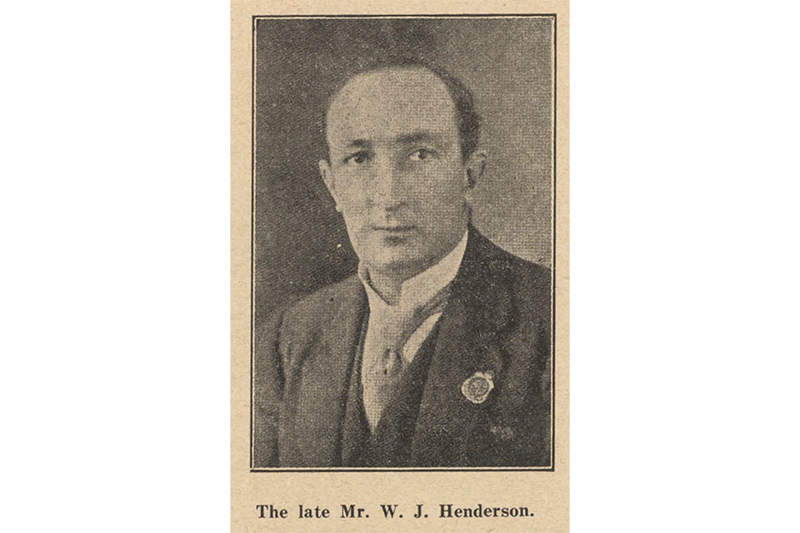
William J. Henderson was the RSSILA’s fifth General Secretary. He was a veteran of both the Boer War and World War I. (Diggers Gazette, 21 March 1921, 6).
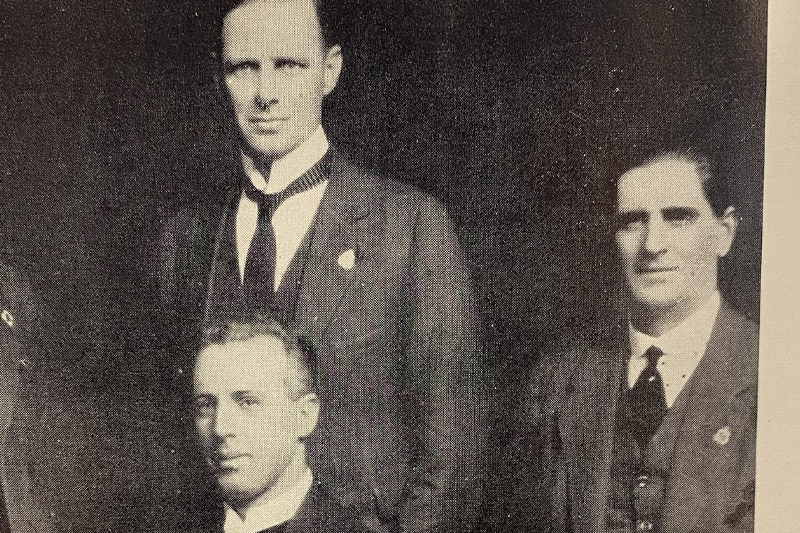
Edward Dibdin (back left) was Queensland State Secretary before being appointed the League’s Federal Secretary in 1924. He is shown with the Federal President Gilbert Dyett (seated) and Frederick Forrest (standing right) in 1927. (Kristianson, 1966).
Another challenge
With the miniature badge adopted, State Branches anticipated that the large version would become redundant. This was not the case.
With Federal no longer managing the badge, the states were left to oversee its roll-out. For new members, nothing changed and an insignia was still issued upon joining. However, for those renewing their subscription, the process varied across jurisdictions.
All State Branches mandated that a miniature badge could only be issued after payment of the annual subscription. However, while Victoria and NSW provided a free insignia, SA, Queensland and Tasmania charged between 10d and 18d per badge.
Understandably, some men refused to pay for a second badge and continued to wear their old one. Most states also required the old badge be surrendered before a new one was issued. In Victoria, however, a man could retain the large insignia for “sentimental or other reasons” if he paid a 12d levy for its replacement.xix
While the miniature badge proved immensely popular and most members adopted it regardless of the conditions imposed upon issue, a minority of men continued to wear the old insignia.
However, with the financial clip no longer fitting the latter, the League feared that these men were unfinancial and abusing the privileges the badge bestowed. This anxiety simmered until 1926, when Queensland became the first State Branch to formally abolish the original badge.xx
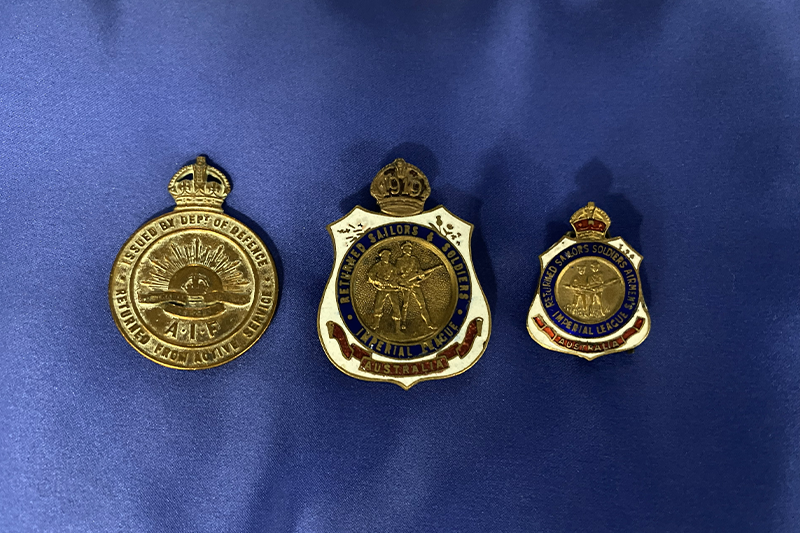
From left to right, the Returned from Active Service Badge, RSSILA Badge with 1919 financial clip attached and the RSSILA Miniature Badge (Source: RSL Queensland Papers).
References
i. G. Potter to W. Burns, 10 January 1918, NAA MSS6609, Box 344. Burns, who was a Queensland member of the League, was appointed Federal Branch’s second General Secretary.
ii. NAA B2455, HASTINGS, R. 530; NSW Government Gazette, 2 May 1919, 2556; Sunday Times, 18 July 1920, 3.
iii. R. Hastings to W. J. Henderson, 11 January 1921, NLA MSS6609, Box 9.
iv. Resolution 27, Federal Executive Meeting minutes, 6 January 1921, NLA, MSS6609, Box 611.
v. R. Hastings to W. J. Henderson, 11 January 1921, NLA, MSS6609, Box 9.
vi. W. J. Henderson to R. Hastings, 17 January 1921, NLA, MSS6609, Box 9.
vii. R. Hastings to W. J. Henderson, 2 March 1921, NLA MSS6609, Box 9. For membership in 1920 see: G. L. Kristianson, The Politics of Patriotism: The Pressure Group Activities of the Returned Servicemen’s League (Canberra, ANU Press, 1966), 234.
viii. R. Hastings to W. J. Henderson, 11 January 1921, NLA, MSS6609, Box 9.
ix. E. Dibden to W. J. Henderson, 3 February 1921, NLA MSS6609, Box 9.
x. R. Woodhead to W.J. Henderson, 26 January 1921, NLA MSS6609, Box 9; & Federal Branch Circular, 18 February 1921, NLA MSS6609, Box 9.
xi. A. L. Knowles to W. J. Henderson, 2 February 1921, NLA, MSS6609, Box 9.
xii. Kristianson, Politics of Patriotism, 234; & R. Hastings to W. J. Henderson, 2 March 1921, NLA, MSS6609, Box 9,
xiii. R. Hastings to W. J. Henderson, 2 March 1921, NLA, MSS6609, Box 9.
xvi. Diggers Gazette, 21 March 1921, 6.
xvii. F. E. Forrest to E. J. Dibdin, 21 May 1921, NLA MSS6609, Box 393.
xviii. E. J. Dibdin to F. E. Forrest, 1 June 1921 and 8 June 1921: NLA MSS6609, Box 393.
xix. Congress minutes suggest that only Tasmania contested the change at Annual Congress. RSSILA: Minutes of the Sixth Annual Congress, 2 August 1921, NLA MSS6609, Box 390.
xx. Federal Branch Circular 101/22, 6 September 1922, NLA MSS6609, Box 455.
xxi. Townsville Daily Bulletin, 2 August 1921, 3; Daily Advertiser, 1 September 1921, 2; Daily Telegraph, 15 December 1921, 2; Horsham Times, 6 January 1922, 5; Wooroora Producer, 16 February 1922, 3.
xxii. Federal Branch Circular 41/26, 12 March 1926: NLA MSS6609, Box 456.