04 December 2025
The history of the RSL badge
Following the Armistice that ended World War I in November 1918, the Returned Sailors and Soldiers’ Imperial League of Australia (RSSILA – now the RSL) anticipated a surge in membership as men returned home. However, sourcing enough badges to meet this demand proved challenging, and the insignia’s scarcity compromised the effectiveness of the League’s recruitment efforts.
Transitioning to the RSSILA
In early 1917, RSSILA Queensland Branch watched with alarm as its hard-won membership plummeted from 1,409 to 459 men. In January, the RSSILA’s first subscription of 10 shillings was due. It was 4 pence (d) more than that of the Returned Soldiers’ Association (RSA) and those who joined the League in late 1916 were unprepared to pay another full subscription. i
Queensland’s efforts to rebuild its membership were stymied by both the state’s vast geographic area and confusion that a new Brisbane-based association – the Returned Soldiers’ and Patriots’ National League – caused amongst newly returned men. A Country and a City Organiser were employed to support recruitment and by the end of 1917, Queensland Branch was 2,233 men strong.ii
Gallipoli veteran William Fisher was appointed Queensland’s third State Secretary in November 1917. A bout of typhoid fever led to his discharge and once back in Brisbane, Fisher took an active interest in the RSA and then RSSILA. As State Secretary, he was instrumental in rebuilding membership.iii

Delegates who attended the RSSILA’s 1919 Federal Conference included General Secretary William Henderson (seated middle row, far right), Acting General Secretary Alfred Morris (seated front row, fourth from left) and Queensland State President Pearce Douglas (seated middle row, third from the left). Photo: State Library of South Australia.
Membership grows
Fisher anticipated that League membership would skyrocket once demobilisation commenced. In addition to the 1,000 insignia that Federal Office (RSL Australia) was issuing to State Branches each month, he had stockpiled around 400 badges.
However, with recruitment exceeding 600 men per week, demand quickly outstripped supply and by March 1919, Queensland Branch was “… absolutely out [of badges] and losing members fast”.iv
With other states experiencing similar challenges, the League’s General [National] Secretary, William Henderson, contracted three additional companies to strike another 50,000 badges at 15-18d each. These orders coincided with a Federal Government contract for 1.6 million Peace Medals for school children.
Supply of the insignia limped along as the impact of the Government order affected an industry already struggling under the effects of an influenza pandemic and post-war industrial action.v
For Fisher – who had worked diligently to rebuild Queensland’s membership – seeing men turn away from the League over the availability of a badge was inexcusable.
“I could foresee in January what was going to happen,” he complained to Henderson.vi
Despite reassurance that similar demands were being received from all State Branches, Fisher remained unmoved.vii As the frequency of his communications to Henderson increased, so too did his frustration “[One] hundred [badges are] practically useless,” he criticised after a delivery of insignia again fell short of his expectations.viii
Queensland goes rogue
The RSSILA’s 4th Federal Congress (the Annual General Meeting of members) was underway in Adelaide when delegates learned that Queensland had ordered 20,000 badges from Brisbane jeweller Wallace Bishop.ix They immediately passed a motion that “absolutely prohibit[ed] any Branch from having badges manufactured”.x
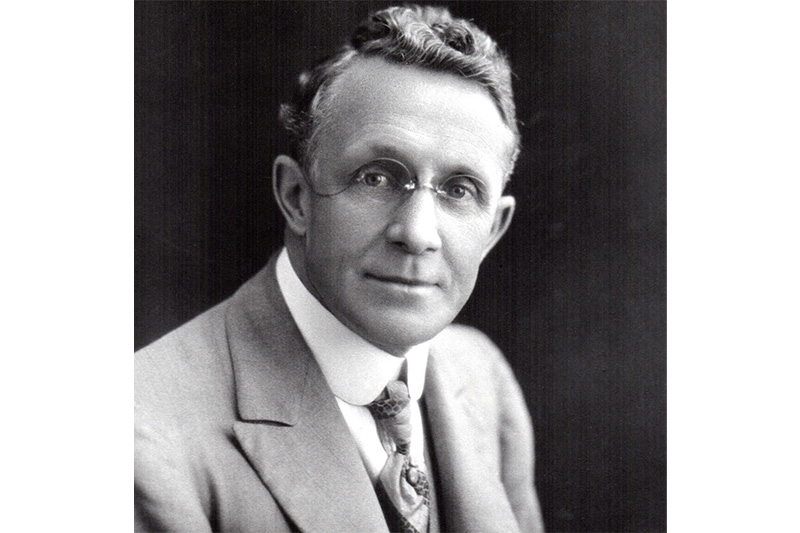
A month later, Acting General Secretary Alfred Morris was managing six different contracts for more than 70,000 badges (with Stokes and Sons, C. G Roeszler and Sons, and Bridgland and King in Melbourne; Prouds Ltd and Simes Ltd in Sydney; and Austral Engraving Co in Perth). He finally took Queensland’s unrepentant State Secretary in hand when Fisher continued to exceed the authority of Federal Office.xi
The end of the badge crisis
With the Government’s Peace Medal struck, the League finally began receiving an acceptable quantity of badges as manufacturers in the southern states progressively completed their contracts. In early November 1919, Morris received advice from the State Branches that their demands for badges had been met.xii
However, in Queensland, Bishop was still to supply 15,000 insignia. With State Branches no longer ordering badges, Federal Office did not have the funds to pay for excess stock.xiii
Morris explained the situation to Bishop and trusted this would release the League from its agreement. The Brisbane jeweller reminded Morris that significant expense had been committed to the contract before adding that the “price [of 15d per badge] would have been much higher for a smaller quantity”.xiv
Morris may have accepted Bishop’s response had he not recently learned some startling information about another contract.
“Someone has been on a good wicket”
With demobilisation ending, a firm of Sydney badge makers was desperate for work. During the shortage, Prouds subcontracted Amor Limited to manufacture around 40,000 RSSILA badges.
With its obligation fulfilled, Amor was now free to negotiate its own contract with the League and at half the price charged by other firms.
“It is pretty clear that Prouds have been on a good wicket,” intimated the NSW State Secretary to Morris, before adding: “…it looks as though some pretty stiff profiteering has gone on”.xv
Armed with this information, Morris responded diplomatically but directly to Bishop. He reiterated the League’s position while also disclosing his awareness that the price of badges had been grossly inflated during the period of the RSSILA’s contracts.xvi Bishop compromised and reduced the contract to 10,000 badges.xvii
With the badge crisis over, Federal Office settled back into the routine of issuing badges to State Branches on a regular and controlled basis.
This would not last long. In 1921 another badge-related headache emerged to vex Federal Office.
Part three of the history of the RSL badge will continue in a future edition of Queensland RSL News.
References
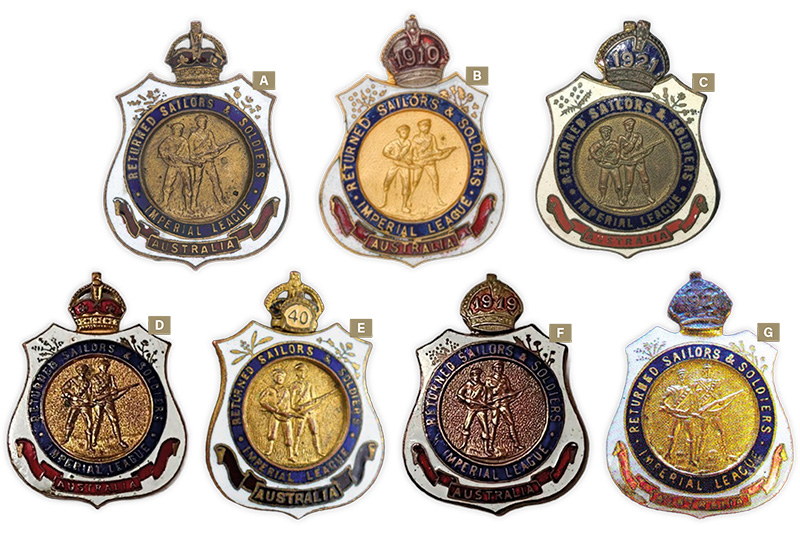
A: Stokes and Sons (Victoria) was the first company to produce badges for the League (Australian War Memorial).
B: Bridgland and King (Victoria) with 1919 financial clip attached (Australian War Memorial).
C: C. G. Roeszler and Sons (Victoria), with 1921 financial clip attached (Victoria Collections).
D: Prouds (New South Wales) contracted Amor Ltd to produce its badges for the RSSILA (Photo: Lindsay Elmore).
E: Austral Engraving Co (Western Australia), with a small 1940 financial clip attached to crown (Collections WA).
F: Simes (New South Wales), with 1919 financial clip attached (image courtesy of Lindsay Elmore).
G: Wallace Bishop (Queensland) was the last company contracted to produce badges in 1919. Shown with 1920 financial clip attached (Victoria Collections).
i Northern Miner, 3 February 1917, 5; & Queensland State Secretary to General Secretary, 30 June 1917, NLA: MSS6609, Box 344. RSA membership in Queensland was initially set at 5 shillings but was subsequently raised to 6 shillings.
ii Nurses had not yet started to join the RSSILA. Queensland State Secretary to General Secretary, 30 June 1917, NLA: MSS6609, Box 344; Brisbane Courier, 29 January 1918, 6 & G. L. Kristianson, The Politics of Patriotism: The Pressure Group Activities of the Returned Servicemen’s League (Canberra, ANU Press, 1966), 234.
iii J26, M333; & B2455 Fisher, W. A: National Archives of Australia (NAA); & Brisbane Courier, 10 November 1917, 5.
iv Fisher to Henderson, 21 March 1919, NLA MSS6609, Box 349; & RSSILA: Queensland Branch, 1918 Annual Report, 12. NLA, MSS6609, Box 324.
v Henderson contracted an additional 10,000 badges from Stokes and Sons in early March and commenced new contracts with Bridgland & King and Prouds in late March: Henderson to Stokes, 3 March 1919, NLA MSS6609, Box 349; & Prouds to Henderson, 28 March 1919, NLA MSS6609, Box 398; Telegraph, 11 March 1919,7; Daily Mail, 7 April 1919, 8.
vi Fisher to Henderson, 21 March 1919, NLA MSS6609, Box 349.
vii Henderson to Fisher, 12 April 1919, NLA MSS6609 Box 349.
viii Fisher to Henderson, 26 March 1919, NLA MSS6609, Box 349.
ix Fisher to P. Douglas, 21 July 1919, NLA MSS6609, Box 349.
x Federal Congress Minute No.137, 21 July 1919, NLA MSS6609, Box 625.
xi The six contracts were with: Stokes & Sons (Vic); C. G. Roeszler & Son (Vic); Bridgland & King (Vic); Prouds (NSW); Simes (NSW); and Austral Engraving Co (WA); Morris to Fisher, 16 August 1919, NLA MSS6609, Box 331.
xii Morris to Wallace Bishop, 15 November 1919, NLA MSS6609, Box 331.
xiii Geelong Advertiser, 11 July 1919, 2; Morris to Fisher, 1 December 1919, NLA MSS6609, Box 331.
xiv Morris to Bishop, 15 November 1919, NLA MSS6609Box 331; Bishop to Morris, 18 November 1919, NLA MSS6609, Box 331.
xv Amor Limited to NSW State Secretary, 11 November 1919; Amor Limited to Victorian State Secretary, 14 November 1919; & NSW State Secretary to Morris, 17 November 1919, NLA MSS6609, Box 975.
xvi Bishop to Morris, 18 November 1919, NLA MSS6609, Box 331.
xvii Morris to Bishop: 22 November 1919; & 5 December 1919, NLA 6609, Box 331.