
25 May 2026
James Canuto: A leader in war and peace
As a kid, James Canuto dreamed of adventure.
But adventure didn’t always come easy. James was classed as an ‘Assisted Aborigine’, unable to leave his hometown without a permit.
The Army was his way out.
Duty calls
At just 20 years old, James enlisted alongside his next-door neighbour.
Soon after, James was deployed to Vietnam for his first tour.
“It was going to be my first trip on a military aircraft (an American C-130 Hercules),”
“Jokingly, the Loadmaster said, ‘Welcome aboard this flight to Nui Dat. The flight will take 40 minutes. If you look above you, you will see a set of lights. At the moment, they're showing white. If they turn green, we're taking enemy fire. If they turn red, we're going to ditch the aircraft.’ So, for the entire 40-minute flight, I didn’t take my eyes off those lights.”
“When we got to Vietnam, we flew into Tan Son Nhu Airbase. That was the busiest airport in the world in 1969."
Landmines, grenades and... red ants
Over the next year, James would work as an armoured vehicle operator, driving M113A1 APCs in dangerous enemy territory.
“Some of our biggest concerns were landmines, rocket propelled grenades (RPGs), and red ants,” he recalls.
“The worst days were Mondays, specifically Mondays during the dry season, because we’d have to check for mines. During the wet season (when the rain fell from 4.00pm to 7.00pm), the mines couldn't function properly, but during the dry season, the batteries never got affected.
“Then there were the ants! The antennas of the vehicle would flick the nest up in the trees and the nest would sometimes fall right into the driver's lap. You’d see this 52-ton vehicle going through the bush and suddenly come to a full stop: the crew bailing out, armed with cans of fly spray.”
Image Credit: The Australian War Memorial
Near misses and lifelong mates
Red ants would soon become the least of James' problems. Throughout his two tours of Vietnam, James and his comrades experienced near misses on a regular basis.
One story he recounts is of his mate, who survived a near death explosion on the way to secure a landing pad for a medical helicopter. In the unit, the commander was nicknamed Charlie Charlie, and the driver, Jockey.
“In our three-car convoy where I was in the second vehicle, the first two went over a bump in the road,” he recalls.
“But my friend who was the Jockey driving the third vehicle wanted to give his Charlie Charlie a gentle ride, so he went around that bump. That's where the switch was and up he went.”
Getting out of his vehicle to help his friend, James realised that there were three injured parties that needed his immediate attention.
“In that moment, the Jockey asked me to shoot him. The next time I saw him was October 1970, back in Sydney, and I said, ‘Look at you, you silly bugger. Six months ago, you asked me to shoot you, now you're walking around.’ He had a back brace on, but he was alive.”
Ike, another good mate of James’, had a similar close call while towing a broken-down vehicle back to their nearest NDP (Night Defence Position).
“We were prepping the vehicle to be towed, and Ike was sitting in the driver’s seat. I said, ‘What are you doing in there? You’re not supposed to travel in a vehicle that’s being towed,’ and he said, ‘Oh, Jimmy, that’s draining. Don’t worry about that. I’ll stay here. I’ll be right,’ and off we went.”
James remembers that they must have moved about 20 metres along Route 329 before there was an almighty explosion.
“I jumped out of my seat and looked around frantically. The commander was standing in his turret with his headset knocked off his head and his hair was pointing straight up, but he was alright.
“There was black oil everywhere I looked, but that’s when I spotted Ike – uninjured and smiling.
“I yelled, 'What the hell happened to you?’ and Ike responded, ‘Well, a mate I made at Kapooka came past and said I should come for a walk with them. So, I jumped out of the driver’s seat and went for a walk.’”
James couldn’t believe it – “Ike was one lucky guy.”
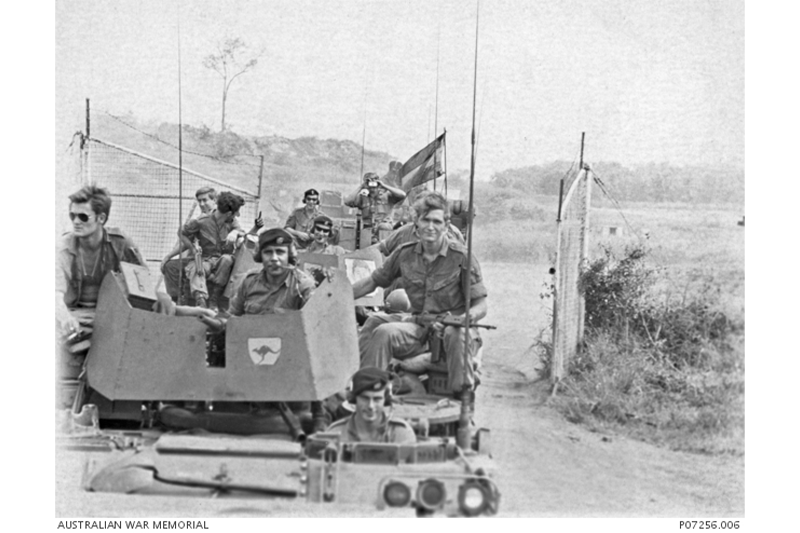
Image Credit: The Australian War Memorial
Vietnam and beyond
James deployed for his second tour to Vietnam in 1971 as a Corporal, eventually returning to Australia in March 1972 after “655 days in the war zone”.
For the remainder of his military career, James was posted around Australia, including Townsville, Puckapunyal and Sydney, and was discharged in 1989 with the rank of Warrant Officer Class Two.
After service, James returned to Yarrabah to be with family, and pursued a career in aged care, often leading ANZAC Day commemorations with staff and residents.
In the years since, he has become a steady leader in the Yarrabah community, helping to found Yarrabah RSL Sub Branch, and residing as president of the local football club.
Reflecting on his service, James says, “I was a leader in war, and peace, and not too many Indigenous people have done that.”
“I'm proud to have served. I wear my medals on ANZAC Day; I'll wear them any opportunity I have. And it’s not just me. Indigenous veterans wear their medals like any other soldier.”
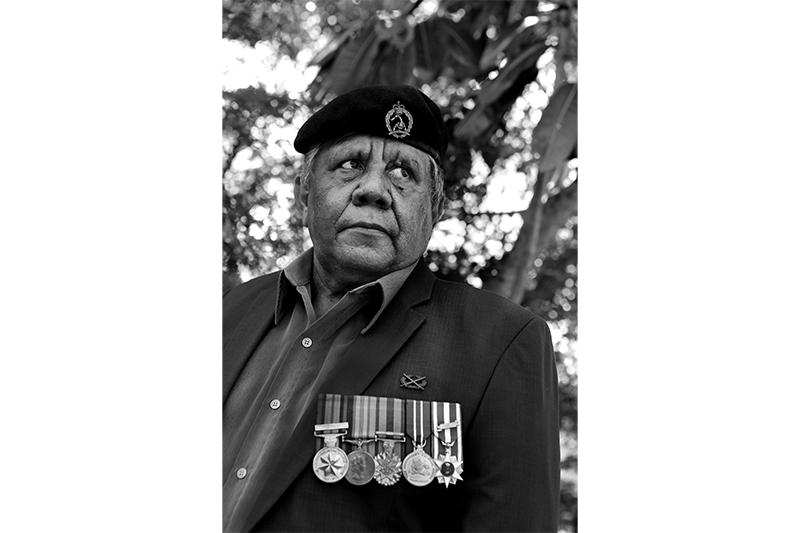
Image Credit: Portrait of James Canuto from the Serving Country Project by Belinda Mason OAM
The cost of freedom
Beneath the accolades and larrikin grin lies a hard truth.
For all his bravery and sacrifice in Vietnam, James was still, in many ways, a prisoner in his own country. That was, until a letter from the government arrived during his first tour.
The letter read, ‘Dear Mr. Canuto, it has come to our attention you have joined the Australian Army. Therefore, you are no longer considered an Assisted Aborigine, and you are free to travel anywhere.’
James hopes the prejudices of his childhood can be left behind so the next generation can live without limitations.
“A lot of kids don't want to leave Yarrabah because they still think that the world is flat. That if they go past Gordonvale, they're going to fall off,” he says.
“But the world's not flat anymore. You can go anywhere."
Indigenous Veterans’ Ceremony
The annual Indigenous Veterans’ Ceremony recognises all Aboriginal and Torres Strait Islander peoples who have served in Australia’s armed forces.
Join us in person or online to commemorate their invaluable contribution.