
17 May 2026
From Manly to Villiers-Bretonneux: Jessie’s search for her ancestors
A family connection
Whilst Year 11 Moreton Bay College student, Jessie Hawkins, might have heard about the Premier's Anzac Prize from her mum, she already had a strong connection to the Defence Force – her grandfather, Alex Cockerill, had served with 549 Squadron during WWII as a Leading Aircraftman.
"I never got to meet him, but my mum has shared what stories she could. He didn't like to talk about it much," Jessie said.
As one of eight Queensland students participating in the Premier's Anzac Prize Jessie has been able to research and learn a lot more about her grandfathers’ military career.
"It's really meant a lot to our family to rediscover this part of our history. It’s been a life-changing experience," she reflects.
Lost but not forgotten
When Jessie came to Brisbane for the three-day Young Historians Workshop in January, she wasn’t expecting to find another connection – this time on her father's side.
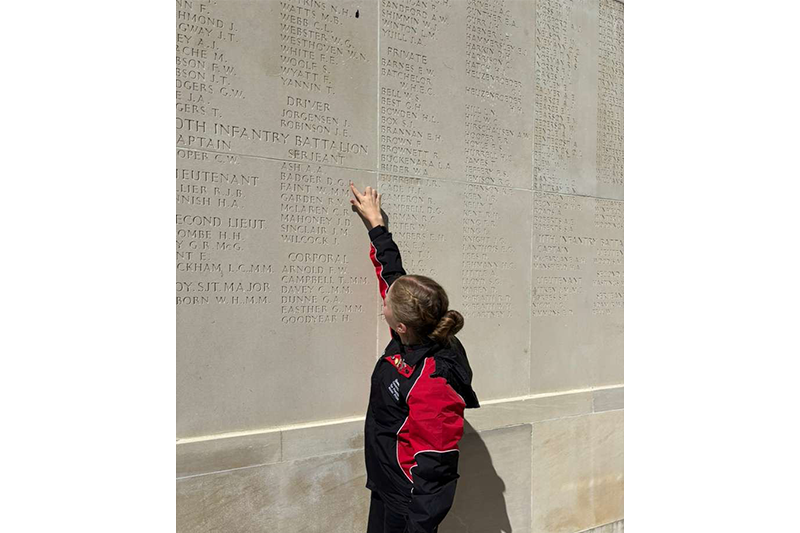
Sergeant David Gibson Jude Badger enlisted on May 24, 1915, and sailed from Adelaide on RMS Morea in August 1915 with the 3rd Reinforcements. He fought along the Western Front, including at Pozières, and was promoted to Sergeant in August 1916. As Sgt of B Company, he was leading his men during the Battle at Mouquet Farm when a shell landed amongst them. Unfortunately, he was killed alongside several of his men, aged 21.
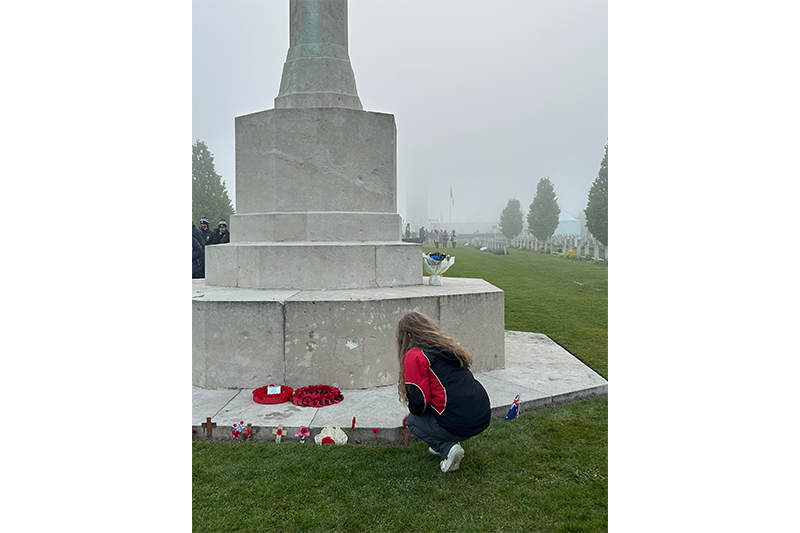
His memorial is at Villiers-Bretonneux, where Jessie and her fellow students took part in this year's ANZAC Day Dawn Service.
"It was so surreal to see his name alongside tens of thousands of soldiers carved into the wall," Jessie said.
"Some of the others in my group did eulogies there, and it really brought home that they aren’t just names, they are people with families like ours."
From the memorial, the group travelled to Mouquet Farm - the very ground where Sgt Badger was killed.
"I always imagined it would be this massive war zone," Jessie remembers.
"But when we got there, it just looked like a normal farm. And yet so many Australians - so many people - are still buried there, and no one knows where they are. Their families don't know where they are. Our family doesn’t know where he is.”
“It was really quite surreal to think he made that same journey, from Australia all the way to France, and was fighting in those exact places where I was standing.”
Nothing can prepare you
One of the most striking revelations for Jessie was the reality of No Man's Land. Standing on the German frontline at Fromelles, their tour guide pointed out the Allied frontline just 300 metres away -easily visible across what is now a quiet, grassy field.
"In films and textbooks, you always imagine the front lines are kilometres apart," she said.
"But I was standing on the German frontline and could see the Allied frontline. I could have run it in under a minute. And yet thousands of Australians died in that gap."
Walking over shell craters and stepping into preserved trenches made the human cost impossible to ignore. "Seeing pictures is just so different to actually being in the space and thinking about what it was like to live there for months on end, hearing shells almost 24-hours a day."
Mateship outside of mates
Before the trip, Jessie had hoped to understand how the ANZACs were remembered outside of Australia. What she found exceeded her expectations.
"In every village we visited - Villiers-Bretonneux, Le Hamel, Bullecourt - the locals were so happy to see us. There were Australian and New Zealand flags everywhere."
That enduring warmth, more than a century on, has shifted how she thinks about those from generations past, and the enduring legacy of the ANZAC spirit.
"You can read that the ANZACs had courage and mateship, but seeing how much they still mean to these little rural French towns makes it real. They didn't just show mateship to their own - they showed it to everyone around them. And 111 years later, that still means something."
Make it personal
For any student thinking about applying for the 2027 Premier's Anzac Prize, Jessie's advice is simple: don't treat it like a history assignment.
"Just show who you really are. Choose something about the ANZACs and their legacy that you're genuinely passionate about and delve into it.
And for those wondering if it’s worth it? "One hundred percent. The number of things I learned that you could never get from a textbook is incredible. It is most definitely worth it."
RSL Queensland has partnered with the Queensland Department of Education to sponsor the Premier’s Anzac Prize.
The Premier’s Anzac Prize is open to Queensland high school students and primary or high school teachers (state and non-state). Students must be in years 8 to 11 at the time of application.
Apply for 2027
Teacher chaperone applications close – Friday 3 July 2026
Student applications close – Tuesday 21 July 2026