
20 July 2026
Maurice Pears remembers the forgotten war
“War is a humbling and poignant experience. It changes your life forever. For me, it was my salvation. In battle, many soldiers and their officers realise, sometimes for the first time, how strong and brave is their fellow man and how deficient is their own character by comparison. Brash and irresponsible young subalterns are pulled together by the sheer guts of their soldiers; the meek and mild of all ranks are strengthened by the performance of their colleagues and the bold are tempered by their fallen comrades. War brings out the best in men as well as the worst.”
– Lieutenant Maurice Bertram Pears (2/35017), 3rd Battalion, Royal Australian Regiment, 1951
Building a soldier
On 14 November 1929, in the midst of the Great Depression, Maurice Pears came into the world. Born to a working-class family in Paddington, Sydney, Maurice’s formative years looked like many other children of the era, struggling to make ends meet in the wake of WWII, and unsure of the future that lay ahead.
In 1941, when Maurice was just 12 years old, his father passed away unexpectedly. Unbeknownst to young Maurice, this harrowing event would set the course for the rest of his adult life.
In an interview with the Australians at War Film Archive in 2004, Maurice said, "I think I was very strongly motivated to do something with my life. I was always searching for something that I could do well.”
“When my father passed away, I asked myself, ‘What can I do to make my mark on the world?’, and that’s when I joined the cadets.”
After high school, Maurice thought he might get a job “digging the streets or working on the trains”, but instead, he was selected to apply for the Royal Military College at Duntroon.
“I thought, now here's an opportunity to get a career! School work wasn’t a big strength of mine, so university wasn’t an option. That was really when it all started, and in 1947 I went to Duntroon,” Maurice recalls.
Maurice quickly adjusted to the rhythm of military life with 1st Battalion at Holsworthy Barracks, finding comfort in the routine and sense of camaraderie he’d longed for growing up. In 1950, the very same year he graduated, he was deployed to Korea with the Australian Army.
“I was very proud of being able to graduate because I thought, my life was now complete. I was educated, and I was ready to take on the rest of the world. My first step after Duntroon was onto an airplane to Korea,” he said in a recent interview with the Korean War Legacy Foundation.
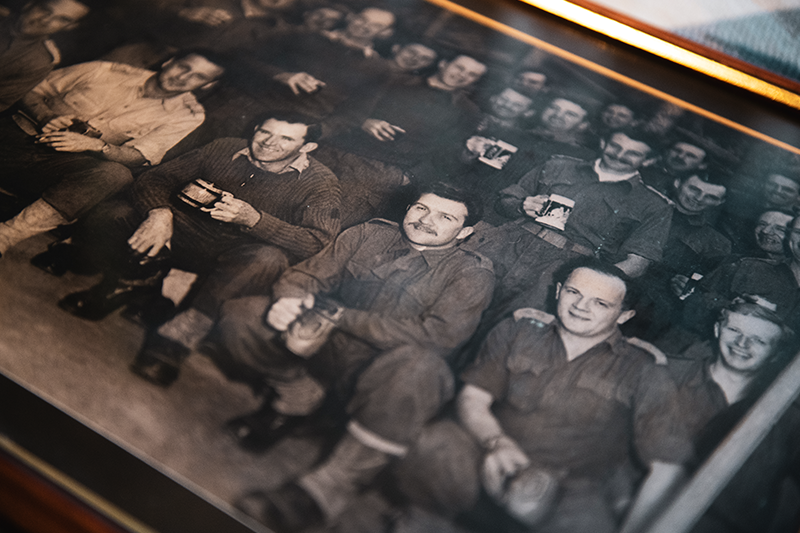
Maurice with officers of 3 RAR (front, second row)
Under fire at Maryang San
It took three days in an unpressurised DC passenger aircraft, travelling through storms and bad weather to arrive in Japan, before Maurice finally reached Korea.
It was there that he embarked on 10 months of active duty as Platoon Commander with 3 RAR, taking part in Operation Minden, and The Battle of Maryang San, including raids on Hills 227, 355, and 317.
During this time, Maurice spent countless days and nights dug in, awaiting enemy attack.
“We lived in fox holes for 5-6 weeks at a time, in the searing heat of summer and the freezing cold of winter, without showers or fresh uniforms. We lived off cold rations and played cards to pass the hours,” he says.
“In the daytime, we tried to clean up our defensive positions, restore the wire, get rid of all the mines, and train so we were ready to go out and do patrols.”
When reflecting on his experiences in the field, Maurice stresses that The Battle of Maryang San was a particularly complex and dangerous conflict.
“Though we lost quite heavily in our casualties, this Battle is recorded as one of the most memorable and significant infantry battles in Commonwealth history. It occurred over five days and we managed to occupy both 355 and 317 which were the two commanding features of the Samichon at the time.
“On one occasion in this Battle, we were shredded with live mortars. My field service pocketbook that I kept in my left upper pocket got a great hunk of shrapnel in it. It was a very difficult time. But, if we hadn’t kept going, it would have been disastrous.”
Maurice has captured this and many more stories from the frontline of the Korean War in his 2013 book, Battlefield Korea.
Honour and bravery on the battlefield
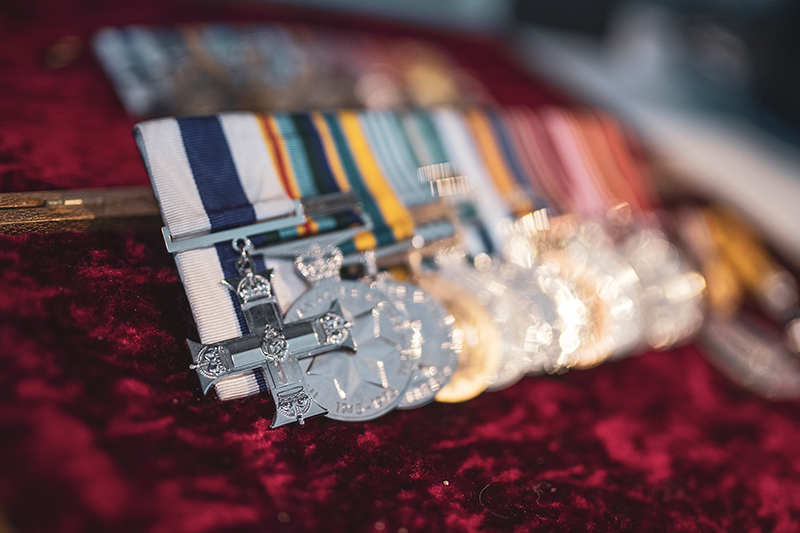
It was Maurice’s bravery and tireless contributions to the Battle of Maryang San that would later earn him a Military Cross.
His commendation reads:
Throughout his ten-month service with 3 RAR, Lieutenant Pears displayed courage and ability of a very high order. During the heavy fighting in October/November 1951 in the area of Point 317, Lieutenant Pears commanded a platoon from C Company. He led the platoon with great dash and determination and was, to a large extent, responsible for the success achieved by his company in that operation. At all times throughout periods of heavy shelling and close-quarter fighting, his courage and qualities of leadership were outstanding. Although wounded at one stage of this action, he carried on for several days until a comparatively quiet period permitted his being evacuated for treatment.
In subsequent operations, Lieutenant Pears maintained this high standard. In a company raid on Point 227 in March 1952, Lieutenant Pears commanded the supporting platoon and his steadiness despite the heavy enemy shelling and mortaring which killed and wounded five men sharing his own and adjacent pits was an inspiration to the remaining members of the platoon. All patrols led by Lieutenant Pears were carefully planned and conducted with skills and determination. He established a reputation as being one of the most able platoon commanders in the battalion.
Remembering Korea
75 years on, we remember both the Battle of Kapyong and the Battle of Maryang San and all those who served in the Korean War, including those who lost their lives.
Even after Maurice retired from his 23-year career in service, he remained a staunch advocate for veterans. For over 60 years, he has been a member of Surfers Paradise RSL Sub Branch and contributed to countless commemorations, events and initiatives to support his comrades in arms.
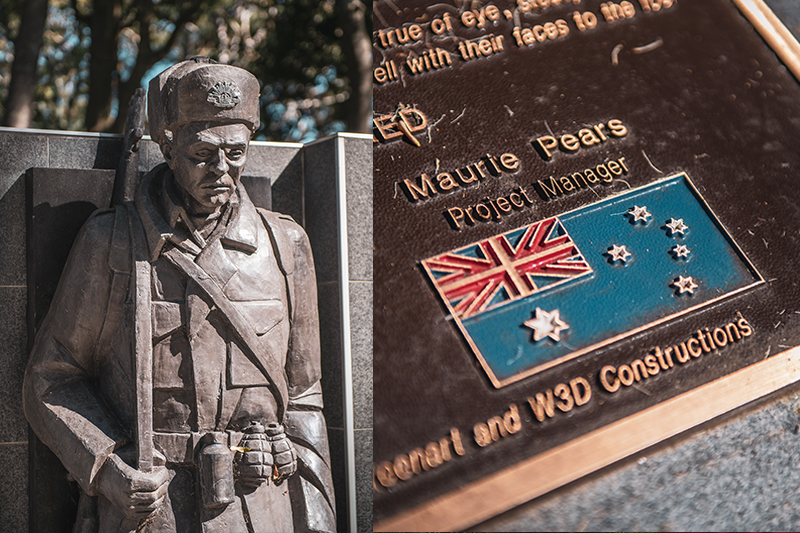
Today, at the age of 96, his legacy lives on in the Queensland Korean War Memorial on the Gold Coast.
“After I retired, I was looking for something to do. I was involved with RSL Queensland through my local Sub Branch in Surfers Paradise and I thought it’d be nice if I could build a memorial to honour Korean veterans,” Maurice says.
“In my mind, everyone had forgotten about Korea, and I wanted to build something that would stand the test of time.”
With the support of local government, the Gold Coast City Council, the Korean War Legacy Foundation and the Korean Embassy, the Queensland Korean War Memorial was erected in 2011.
The Memorial not only honours the 17,000 volunteer veterans of the Navy, Army and Air Force who fought in the Korean War, but it also remembers the veterans and citizens of the Republic of Korea.
“To the war veteran, a memorial is a living, breathing thing that grows in stature as time passes. It is the soul and spirit of those who returned and those 340 who failed to return and who now sleep in the bosom of the Korean people in Busan,” Maurice says.
“It is a place of homage for the veterans and their loved ones and a place of tribute for those who will follow.”
Korean Veterans’ Day
Korean Veterans’ Day (27 July) marks the anniversary of the armistice that ended the Korean War (1950-53).
More than 17,000 Australians served in the Korean War, supporting South Korea alongside 20 other allied nations in defence of freedom and peace. Tragically, some 340 Australians lost their lives, more than 1,200 were wounded, 29 were taken prisoner, and more than 40 remain missing in action.
These efforts went largely unnoticed in Australia, causing added suffering for many who served in the so-called ‘forgotten war’.
On 27 July, join us in remembering the invaluable contribution of Korean War veterans.