
10 September 2026
A home for the League: A truly useful war memorial – Part 3
During and after World War I (WWI), the League opposed the construction of symbolic war memorials as it believed commemorative halls were a more appropriate form of remembrance as they gave returned men somewhere to meet and socialise. Nevertheless, many communities built local war memorials as sites where citizens could gather to collectively mourn the loss of soldier sons.i
In 1921 in Brisbane, the Anzac Memorial Committee was established to determine the form of Queensland’s National War Memorial. Unsurprisingly, the League’s State President, James Caanan, advocated for an “an AIF Memorial Building in a central position” to serve the needs of the state’s returned men.ii
However, given the magnitude of grief being experienced in the community, an elegant cenotaph surrounded by parklands was built to provide “hundreds of relatives [the] opportunity of freely rendering their homage to the glorious dead”.iii
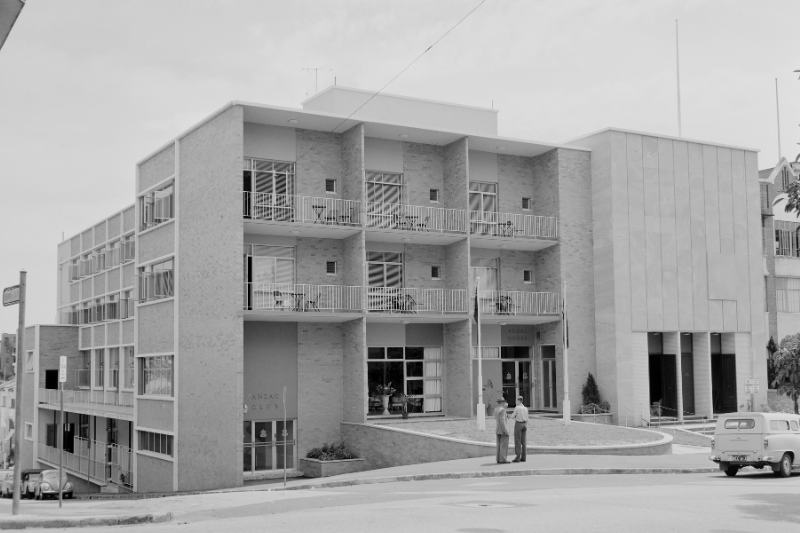
The second Anzac House (since demolished) was located on the corner of Wickham Terrace and Berry Street in Spring Hill (John Tanner, 1960, National Archives of Australia).
Another war, another style of remembrance
After World War II (WWII), many towns and suburbs attached a commemorative plaque to their existing monuments and focused on building useful forms of remembrance: war memorial hospitals, swimming pools, halls and libraries. These provided Australia’s growing population with practical structures that recalled the cost of war in their everyday use.iv
For the Returned Sailors’, Soldiers’ and Airmen’s Imperial League (RSSAILA), this change conformed to its earlier stance regarding memorialisation. In June 1944, delegates at the Queensland State Congress voted in favour of the League building homes, halls and hospitals as memorials to the current conflict.
A year later, they voted to launch an appeal to build Queensland’s National War Memorial: a new Anzac House. In doing so, the League stamped its authority upon the guardianship of the state’s remembrance practices.v
“A memorial of the greatest utility to all returned men”vi
League members believed the post-war challenges facing the new generation of service personnel were similar to those experienced in 1919. Costing around £200,000, a new Anzac House would become the state’s “Rehabilitation, Reconstruction and Service Centre” and the hub for the League’s post war support of returned servicemen and women”.vii
It would also house the headquarters of the League and its employment and pension (compensation) sections, while providing accommodation for regional veterans visiting Brisbane for treatment.viii
After announcing its plans, State Branch lost little time in selling the existing Anzac House in Elizabeth Street.ix A year later, it vacated the latter and relocated to a temporary home in the Lady Bowen Hospital on Wickham Terrace.x
During the war, this building had served as a servicemen’s hostel, and its spacious dormitories enabled the League to begin offering temporary accommodation to returned servicemen.
Raising the money
Acting Queensland Premier Ned Hanlon immediately kicked off fundraising with a cheque for £5,000. He expressed approval over the “very happy idea on the part of the RSSAILA to develop the proposed centre”, rather than the responsibility falling to the local and state governments as it had after the previous war.xi
In early 1945, Sydney’s Sun newspaper announced a Miss Australia competition to financially support charities working with returning service personnel. In Brisbane, the RSSAILA and Courier Mail worked together to coordinate Queensland entrants.
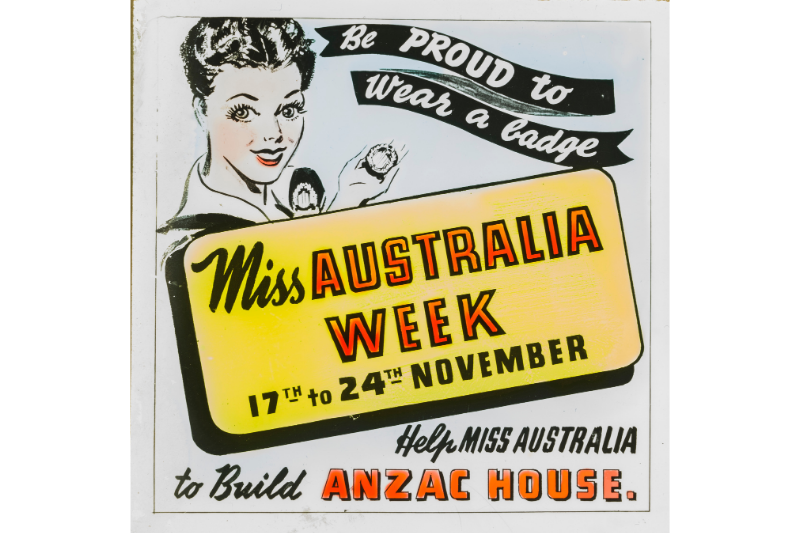
A glass slide used to advertise the Miss Australia Quest in cinemas across Queensland during 1945 (State Library of Queensland).
Sub Branches and other community organisations sponsored young women to vie for the crown and a League entrant – Miss Rhondda Kelly – took the honours after raising £90,000 for the Anzac House Appeal.xii
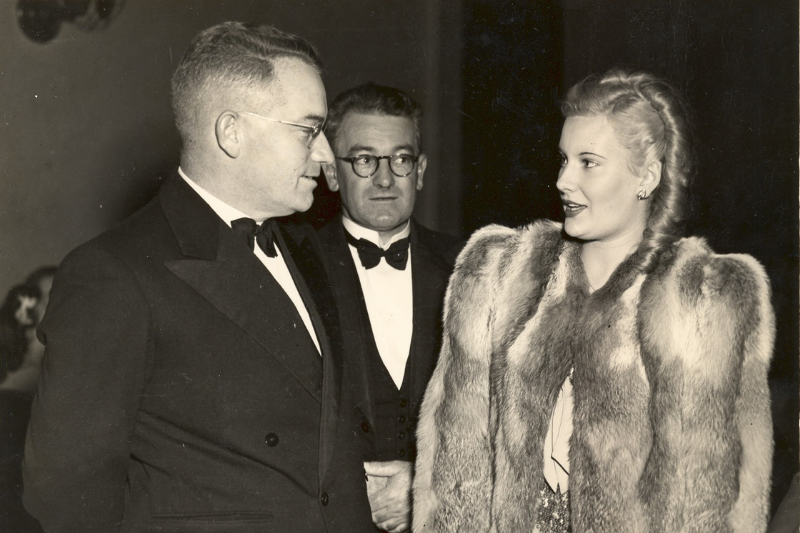
RSL Queensland State President Raymond Huish chats with Rhondda Kelly, the League entrant who won the Miss Australia Quest in June 1948 (Photographer unknown, Huish Papers).
Unexpected delays
After WWII, construction limitations imposed during the Great Depression of the 1930s and wartime shortages of building materials resulted in an acute housing shortage across the nation.xiii Many returned servicemen experienced homelessness, and during its first year in the Lady Bowen Hospital, the League provided 50,000 bed nights to local veterans.
Consequently, the RSSAILA suspended fundraising in 1947 as it believed it to be “unwise, unfair and inconsistent for the League to commence a building project for Anzac House” when it was lobbying the government for adequate housing for returned service personnel.xiv
Locating a suitable site for the new Anzac House was also proving difficult. Finally, in late 1954, the League purchased the Union Jack Club, another servicemen’s hostel on Wickham Terrace that had been run by the state’s nurses during WWII.xv
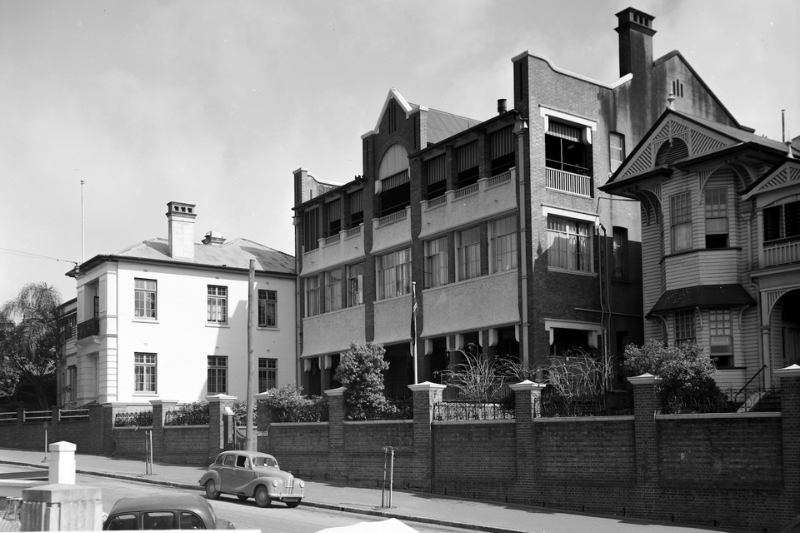
The Union Jack Club (far left and since demolished). During WWII, the Queensland Turf Club donated money to the state’s nurses to purchase this building. Part of the United Services Club can be seen far right (W. A. Jones, c. 1940s, State Library of Queensland).
The League faced one final hurdle when an existing tenant proved difficult to dislodge. It was not until 1958 that it finally took possession of the site and demolished the existing structure.xvi
Novel solutions to meet an unavoidable cost
Fifteen years had passed since a new Anzac House was first proposed. As the memory of the war receded and life moved on, its purpose as the state’s monument to WWII was also forgotten.
By 1958, construction costs had increased by £50,000. Rather than turn to a financial institution for help, State Branch launched the ‘Anzac House Loan’. This gave members, Sub Branches and Districts the opportunity to invest money for five years at a competitive 5% per annum interest rate. The scheme proved so popular that it was offered again in 1964.xvii
In 1959, the state of Queensland celebrated its centenary. Three years earlier, State Branch had launched the Dream Home Art Union to fund its War Veterans’ Homes program. To raise the remaining money for Anzac House, the Art Union combined with a ‘Centenary Queen Quest’, whereby Sub Branches and Districts sponsored young women to raise funds. It was a match made in heaven, with a record £10,700 raised. The following year, in 1960, the League launched the ‘Girl in a Million Quest’ as its major annual fundraiser.xviii
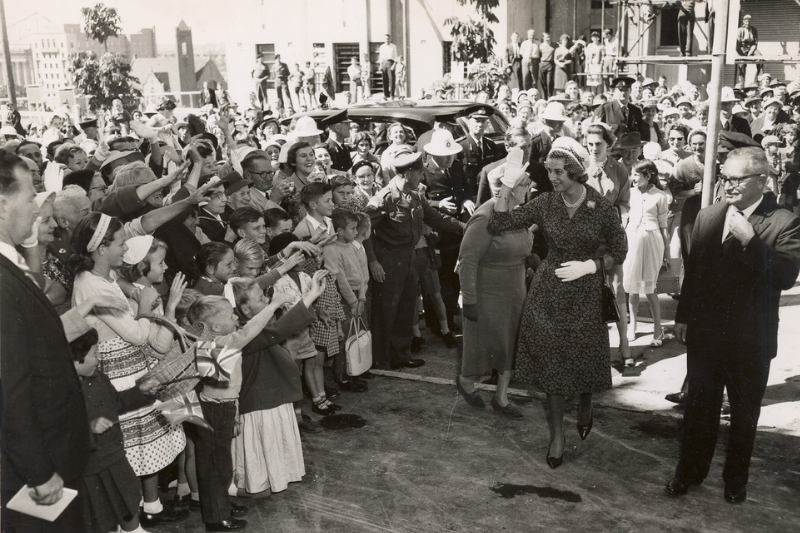
HRH Princess Alexandra, arriving to open Anzac House on 20 August 1959. State President Raymond Huish can be seen far right adjusting his tie (Photographer unknown, Huish Papers).
A royal event
On 20 August 1959, more than 600 returned service personnel and members of the public crowded together on Wickham Terrace to watch Her Royal Highness (HRH) Princess Alexandra officially open Anzac House. Afterwards, the young princess spent time meeting returned nurses and servicewomen before the public was given the opportunity to tour the new facility.
State headquarters was located on the ground floor of the modern four-level building, which was designed by local architect and returned serviceman Godfrey Blackburn. The Anzac Memorial Club occupied its lower level and boasted a kitchen, bar, dining facilities, library, reception and reading and billiard rooms.
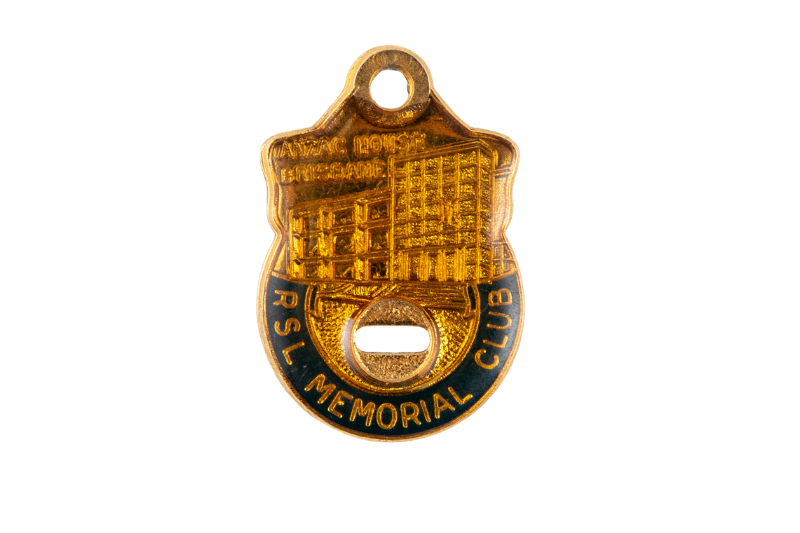
Membership fob for the Anzac Memorial Club. Anzac House can be seen on the upper half of the badge, while the circular slot likely accommodated an annual membership clip like that worn on the crown of the badge.
Members paid a small fee, in addition to their annual subscription, to use the club. The nurses and ex-servicewomen were allocated their own space, while on the upper levels, 34 rooms offered temporary accommodation to single and married returned service personnel visiting Brisbane for rehabilitation needs.xix
With Anzac House finally built and operational, the League turned its attention to constructing a space within the structure that would adequately reflect the service and sacrifice of WWII.
References
i. Ken Inglis, Sacred Places: War Memorials in the Australian Landscape (3rd ed). Carlton: Melbourne University Press, 2008. 134-136.
ii. Minutes of the Anzac Memorial Committee, 11 February 1921, Brisbane Council Archives (BCA) 0542.
iii. Ibid.
iv. Inglis, Sacred Places.
v. RSSAILA, Queensland Branch: 1944 Annual Report, 32; 1945 Annual Report, 32. RSL Queensland Papers.
vi. Telegraph, 8 August 1945, 2.
vii. Queensland Digger, July 1945, 2-3.
viii. Telegraph, 8 August 1945, 2.
ix. Anzac House sold for £15,000: Telegraph, 4 August 1945, 3.
x. Morning Bulletin, 5 July 1947, 10.
xi. Telegraph, 28 June 1945, 3.
xii. Sun, 13 February 1945, 5; Pix, 26 January 1946, 14-17.
xiii. Anne O’Brien, ‘Homeless Veterans – A Short Long History.’ Parity, 2020.
xiv. Queensland Branch, 1948 Annual Report, RSL Queensland Papers; &Morning Bulletin, 5 July 1947, 10.
xv. The nurses donated the money they received for the Union Jack Club back to the League’s War Veterans’ Homes Patriotic Fund. See: Secretary to Ned Hanlon, 11 July 1946; G. Angell to M. Spooner, 9 February 1954; Union Jack Club Secretary to RSSAILA Secretary, 30 June 1955. Box 4, Defence Service Nurses’ Collection, RSL Queensland Papers.
xvi. Queensland Branch: 1955 Annual Report, 3; 1956 Annual Report, 3; 1957 Annual Report, 3; 1958 Annual Report, 21. RSL Queensland Papers.
xvii. Queensland Branch, 1959 Annual Report, 1; Boonah Sub Branch Debenture Book. Box 4, Boonah Sub Branch Collection, RSL Queensland Papers.
xviii. Queensland Branch, 1960 Annual Report, 6& 7. RSL Queensland Papers.
xix. Queensland Digger, August 1959, 2.
Learn more
Keep an eye out for part 4 of the history of Anzac House.
You can read Part 1 in Queensland RSL News, Edition 3 2024, and Part 2 in Edition 4 2024.